
Choosing the right shock absorber manufacturer is an important decision for automotive OEMs, distributors, vehicle manufacturers and other businesses. Shock absorbers directly influence ride comfort, vehicle stability, handling and overall suspension performance. Therefore, selecting a reliable manufacturing partner can have a significant impact on product quality and customer satisfaction.
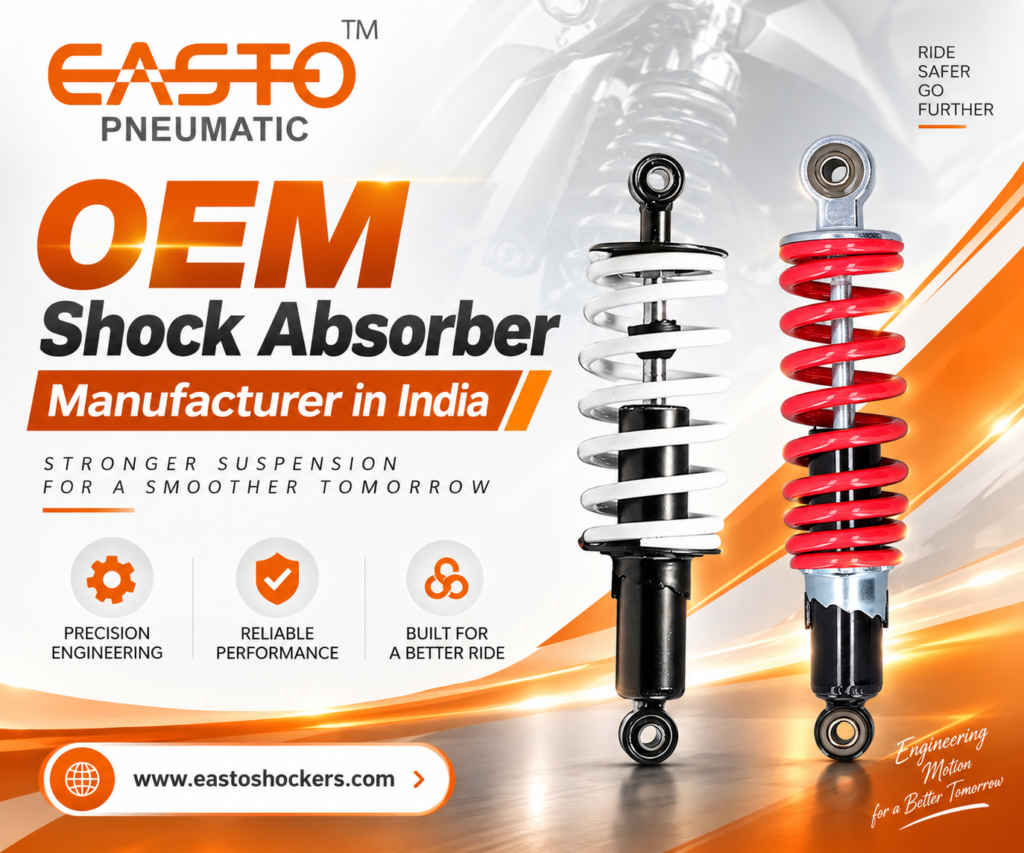
With many suppliers available in the market, businesses should evaluate more than just price. Here are the key factors to consider when choosing the right shock absorber manufacturer.
1. Check Manufacturing Experience
Experience is one of the first factors to evaluate. An experienced manufacturer is more likely to understand different vehicle applications, suspension requirements, manufacturing challenges and quality expectations.
Look for a manufacturer with experience in producing shock absorbers for applications such as two-wheelers, three-wheelers, passenger vehicles, commercial vehicles, EVs, agricultural equipment and industrial machinery.
A manufacturer with established engineering and production capabilities can also provide better support for customized requirements.
2. Evaluate Product Quality
Quality should always be a priority when sourcing automotive components. Poor-quality shock absorbers can affect vehicle stability, handling and passenger comfort.
Before selecting a supplier, ask about:
- Raw material quality
- Manufacturing processes
- Quality control procedures
- Dimensional inspection
- Performance testing
- Durability and endurance testing
- Leakage testing
- Final inspection procedures
A professional manufacturer should have clearly defined quality-control processes throughout production.
3. Look for OEM and Custom Manufacturing Capabilities
Automotive businesses often have requirements that differ from standard aftermarket products. OEMs may require specific dimensions, damping characteristics, mounting configurations or materials.
Therefore, choose a shock absorber manufacturer that can support:
- Custom designs
- Prototyping
- Engineering modifications
- Application-specific solutions
- Bulk production
- Technical specifications
The ability to move from prototype development to consistent mass production can make the supplier a valuable long-term partner.
4. Consider Manufacturing Capacity
Your supplier should be capable of meeting your current and future production requirements.
Before finalizing a manufacturer, understand their:
- Production capacity
- Lead times
- Minimum order quantities
- Inventory capabilities
- Scalability
- Delivery schedule
A manufacturer may provide excellent products but still become unsuitable if it cannot maintain supply when your business grows.
5. Verify Testing and Quality Certifications
Automotive components need to perform reliably under demanding conditions. A good manufacturer should therefore have appropriate testing facilities and quality systems.
Ask whether the manufacturer conducts performance, endurance, damper, oil-leakage and other relevant tests.
Certifications such as ISO 9001:2015 can also indicate that the company follows a structured quality-management system. However, certifications should be considered alongside actual manufacturing and testing capabilities.
6. Check Industry and Application Expertise
Different vehicles require different suspension characteristics. A shock absorber designed for a motorcycle may have completely different requirements from one used in a truck, construction machine or electric scooter.
Therefore, choose a manufacturer with experience relevant to your application.
For example, businesses involved in electric mobility may specifically look for an EV shock absorber manufacturer with experience in electric scooters, electric three-wheelers or other EV applications.
7. Evaluate Engineering and Technical Support
A reliable manufacturer should not simply supply a product; it should also understand the application.
Technical support can be particularly important when developing customized shock absorbers. Look for suppliers that can assist with product development, specifications, prototypes, testing and design improvements.
Good communication between your engineering team and the manufacturer’s technical team can help reduce development time and avoid costly production issues.
8. Consider Global Supply and Delivery Capability
If you purchase components internationally or plan to export vehicles, choose a manufacturer capable of handling global requirements.
Consider their experience with:
- International customers
- Export documentation
- Packaging
- Shipping
- Production planning
- Consistent quality across large orders
A manufacturer with international supply experience can make the procurement process smoother.
9. Compare Total Value, Not Just Price
Price is important, but it should not be the only deciding factor.
A low-cost shock absorber may create higher expenses through premature failures, inconsistent quality, warranty claims or production delays.
Instead, compare the total value offered by each supplier, including quality, engineering support, reliability, delivery, customization and after-sales assistance.
Choosing the right shock absorber manufacturer for your automotive business requires careful evaluation of manufacturing experience, product quality, engineering capabilities, testing facilities, production capacity and supply reliability.
For OEMs and automotive businesses, the ideal manufacturing partner should be capable of delivering consistent quality, customized solutions, technical support and scalable production.
A manufacturer such as Easto Pneumatic can be evaluated on these parameters when sourcing shock absorbers for automotive, EV, commercial vehicle and other specialized applications. The right supplier can become more than a component vendor—it can become a long-term engineering and manufacturing partner for your business.